Solar Faults Your Monitoring App Won't Show, Found Under Warranty
A thermal drone inspection of a 17-month-old, 157 kW rooftop solar system found three panels at fire-risk temperatures, a string of 14 panels producing nothing and 17 bypass diode defects, none of them visible in the monitoring app.
By Art Ryumin6 min readChristchurch
- panels at fire-risk temperatures, up to 138°C
- 3
- panels at fire-risk temperatures, up to 138°C
- panels in one string producing nothing
- 14
- panels in one string producing nothing
- bypass diode defects
- 17
- bypass diode defects
- estimated generation lost a year
- $4,100
- estimated generation lost a year
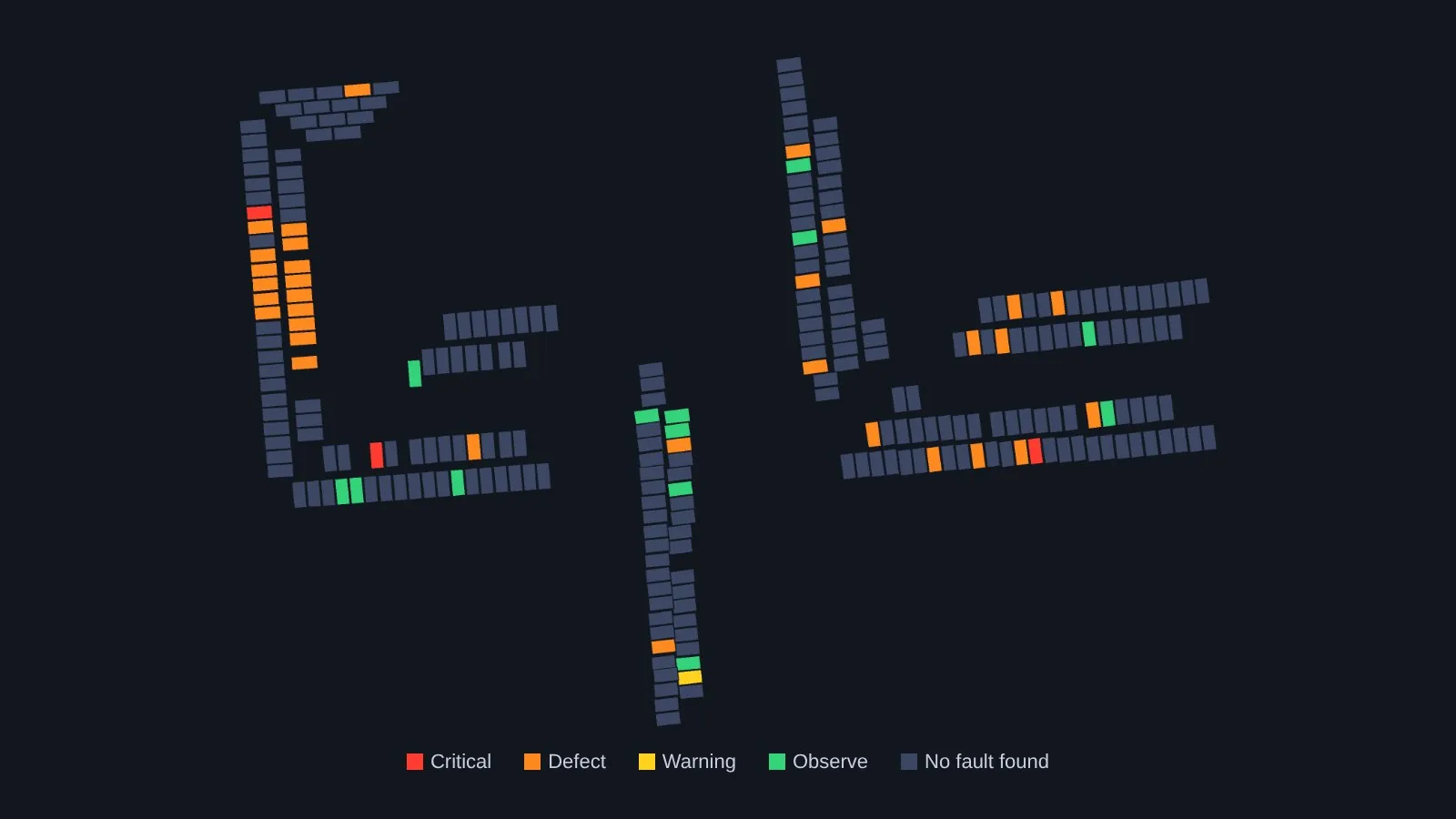
A commercial healthcare facility in Christchurch asked us to inspect its rooftop solar: 157 kW, 270 panels across eight roof areas, installed about 17 months earlier. It had a monitoring app, and from the ground everything looked fine. The general manager wanted a record of each panel's condition while the system was still early in its warranty.
We flew it with a thermal camera on a clear, sunny day in November 2026. There was no scaffolding and no one on the roof, and people on site carried on as normal. Every panel was analysed and given a rating.
- 3
- critical
- 32
- defect
- 14
- warning or observe
Critical: three panels at fire-risk temperatures
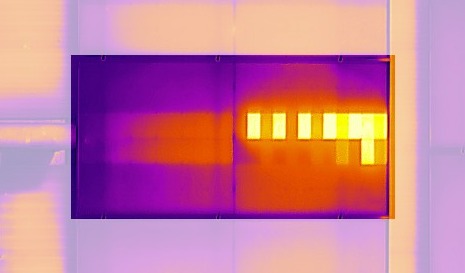
Small patches on three panels reached 82°C, 98°C and 138°C, while the panels around them were at about 60°C. The analysis points to shade from rooftop structures next to the panels as the most likely cause. When part of a cell is shaded, the rest of the panel keeps pushing current through it and the blocked cell turns that energy into heat.
Heat at this level damages the panel and its connections, and spots this hot are treated as a fire risk. They were the first item on the repair list.
Defect: one string offline, 14 panels producing nothing
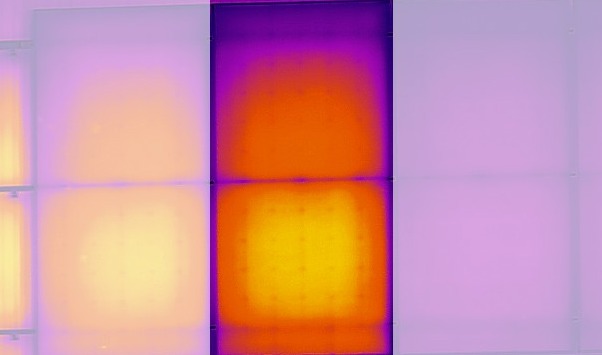
Panels are wired together in groups called strings. One whole string was evenly warmer than its neighbours, the typical sign that it is disconnected from the inverter. The panels were sitting in the sun with nowhere for their power to go.
This single fault accounted for about 7.7% of the system's output, roughly $2,900 a year. It is usually a straightforward repair for an electrician once they know which string to look at.
Defect: 17 bypass diode faults, possibly under warranty
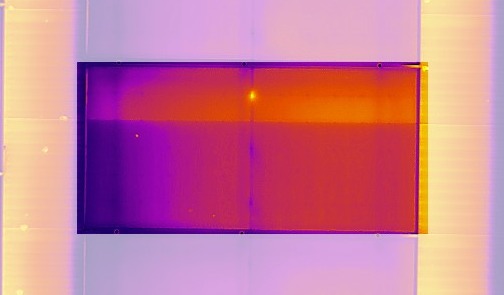
On 17 panels one third of the panel was running warm. Each panel has three bypass diodes that let current skip a shaded section. When one fails or stays switched on, that third of the panel stops contributing, sun or no sun. Together these cost about $890 a year.
Diode faults on panels this new may be covered by the manufacturer's warranty. A claim needs evidence, and the inspection gave the installer a thermal image, panel number and GPS position for each one. One more panel had a 109°C shading hot spot.
The remaining 14 panels were minor: dirt, debris or plant growth on six, two heat reflections that turned out not to be faults, and a few small warm spots to recheck next year.
Why the monitoring app didn't show it
A monitoring app reports what the inverters produce. It can't see individual panels.
The three critical hot spots cost about 0.7% of output, around $280 a year. That is a smaller swing than one cloudy afternoon, so it never shows up as a problem in the numbers. The diode faults were a small drop spread across 17 panels. Even the dead string only looks like a system producing a bit less than expected unless someone compares string by string and knows what output to expect. In all three cases the app could not show which panel was at fault or that one of them was at 138°C.
What the faults were costing
| Finding | Panels | Share of output | Estimated loss a year |
|---|---|---|---|
| Disconnected string | 14 | 7.7% | $2,900 |
| Bypass diode faults and shading hot spot | 18 | 2.4% | $890 |
| Critical hot spots | 3 | 0.7% | $280 |
| Warning and observe | 14 | under 0.1% | $6 |
| Total | 49 | 10.8% | about $4,100 |
That is roughly 18,600 kWh a year, or about $20,500 over five years if nothing is repaired. The figures are modelled from the thermal data at 22c per kWh. They were not measured electrically, but they show where the money is going and which repair pays back first.
Warranties only help if you find the fault in time
A 25-year warranty usually covers panel output. Installer workmanship is often covered for around five years and inverters for five to ten. None of that helps if nobody knows a fault exists. A defect has to be found, recorded and raised while the cover still runs, and dated thermal images located to the panel give the installer or manufacturer something concrete to act on.
The first flight found something else
This was actually our second flight. On the first, in October, every panel showed the same temperature, which only happens when no current is flowing. The whole system had stopped generating three days earlier, and the inverters were sitting in standby. The monitoring app recorded it, but nobody had a reason to open it that week.
We alerted the general manager the next morning, and the installer had it running again eight days after it stopped. We estimate the outage lost 5,700 to 7,050 kWh, worth $1,260 to $1,550. We then re-flew the inspection once the system was running, which is the flight described above.
A 138°C hot spot is a fire risk
A panel running at 138°C in one spot is a fire risk. Concentrated heat like this chars the panel's backing sheet and breaks down its connections and wiring over time, which is how hot spots turn into roof fires. Leaves, nests or other debris trapped against the hot panel add fuel. A fire does the most harm where people can't get out quickly, such as aged care, retirement villages, hospitals and schools. Panels generate whenever there is daylight, so parts of the system stay live even with the mains switched off. Under the Health and Safety at Work Act 2015, whoever manages a workplace has to keep it free of risk so far as is reasonably practicable, and the solar on the roof is part of the building.
For insurance brokers and insurers, an inspection like this gives a dated record of every panel on a roof, each fault rated by severity and located to the panel, and, after a follow-up flight, evidence that defects were repaired. It needs no roof access or shutdown, so it suits risk surveys and portfolio reviews across many sites.
How the inspection was done
For anyone who wants the technical detail: we flew a DJI Matrice 350 RTK carrying a DJI Zenmuse H30T radiometric thermal camera, which records a temperature for every pixel. The flight took place around midday with about 870 W/m² of solar irradiance on the panels, well inside the conditions IEC TS 62446-3 sets for thermal inspection of solar panels. That standard calls for at least 600 W/m², little cloud and light wind, so faults show clearly against the panels around them.
Thermal and colour images were captured for every panel, and each panel was then analysed and rated Critical, Defect, Warning or Observe. Hot spot temperatures were adjusted to standard sunlight so results can be compared between inspections.
What the client received
- A plain-English summary for the general manager, with the findings in order of priority and what each one means
- A full detail report with a photo and thermal image of every flagged panel
- A service report for the installer listing every faulty panel by number and GPS position
- A 3D model of the whole system, with each panel coloured by its rating
- A recommendation to re-inspect after the repairs, before the installer's work is signed off
Drone thermography is a screening method. It shows where to look, and a qualified electrician should confirm each finding before a panel is replaced.
Gallery