Get a Free Solar Assessment
Solar Panel Inspection & Maintenance
From First Flight to Full Life – Complete Solar Asset Care
Drones at Work supports your solar asset through every stage of its life – pre-installation roof assessment, installation progress and defect monitoring, a post-installation health report, ongoing annual or bi-annual thermal inspections, and panel washing. One provider, one point of contact, and a complete condition record from day one.
What We Do
We’ve built a solar care programme that follows your system through its entire life — not just a single inspection. Using thermal imaging, LiDAR and AI-assisted analysis, we help solar installers protect themselves from liability before a single panel goes up, give building owners a clear performance baseline the day a system is commissioned, and keep systems running at their best with scheduled health checks and cleaning for years afterward.
Our Solar Panel Inspection Services
Ongoing Health Monitoring – Annual & Bi-Annual Inspections
A system’s condition doesn’t stand still — dust, shading and ageing components change month to month. We recommend an annual inspection for most sites, or bi-annual for larger commercial and utility-scale arrays, to track how your system’s health changes over time and catch developing faults, such as a bypass diode failure or a bird’s nest under a mounting hook, while they’re still a maintenance job rather than an insurance claim.
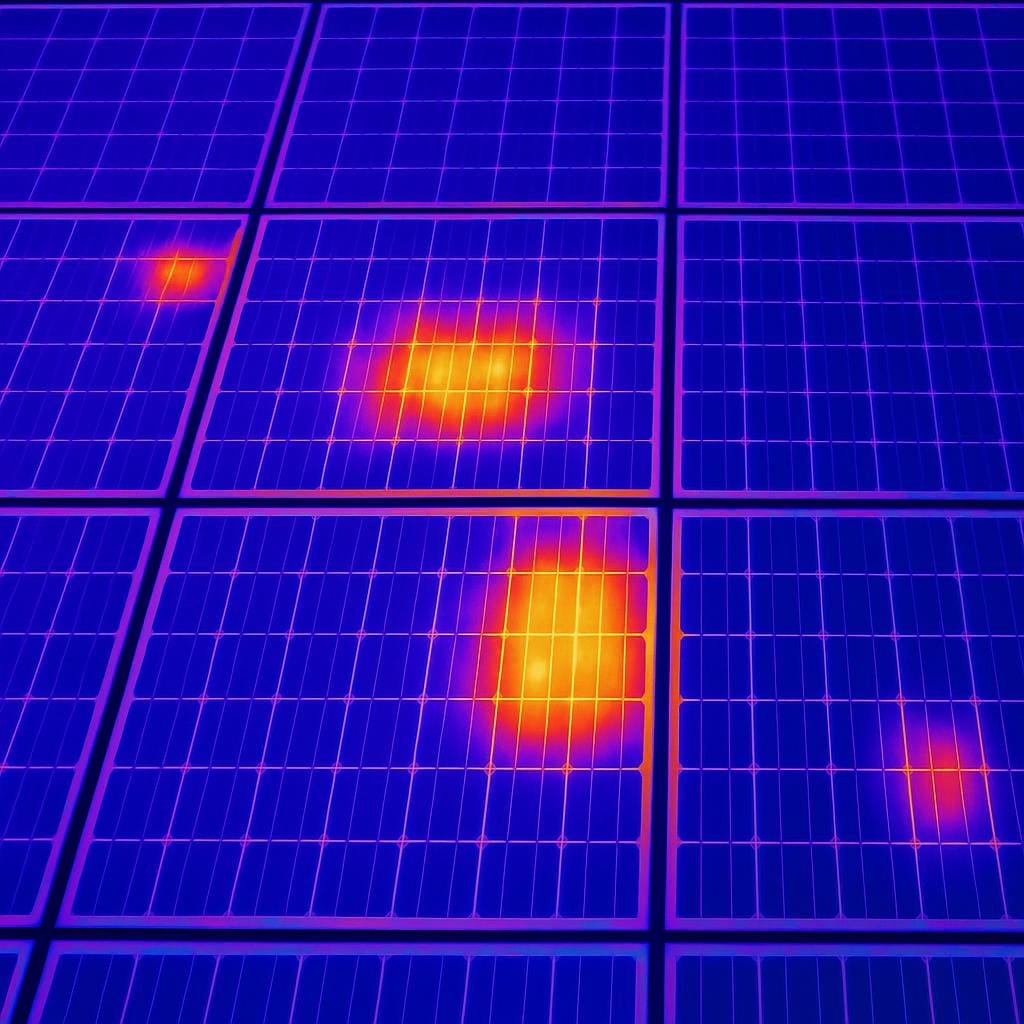
Thermal Performance Analysis: Identify underperforming panels and electrical issues with our advanced thermal imaging technology. Using the H30T thermal payload—the most sophisticated thermal sensor available in commercial drone applications—we detect temperature variations across your entire solar array that indicate potential problems such as:
- Cell fractures and internal panel damage
- Bypass diode failures
- Junction box overheating
- Connection and wiring issues
- String performance inconsistencies
- Potential-induced degradation (PID)
Each thermal anomaly is documented with precise location data and temperature measurements, allowing for targeted maintenance rather than time-consuming manual checks of the entire system. This approach significantly reduces diagnostic time and focuses repair efforts exactly where they’re needed.
Visual Defect Documentation: Complement thermal analysis with high-resolution visual imagery that documents physical panel conditions and installation issues. Our detailed visual inspection identifies:
- Physical damage to panels (cracks, delamination, discoloration)
- Soiling and debris accumulation affecting performance
- Shading issues from nearby structures or vegetation
- Mounting system problems and structural concerns
- Water pooling and drainage issues
- Bird nesting and pest-related damage
The combination of thermal and visual data provides a comprehensive understanding of your system’s condition, supporting both immediate maintenance decisions and long-term performance optimization strategies.
Comprehensive Reporting: Receive detailed, actionable reports that transform complex data into clear insights and recommendations. Our solar inspection reports include:
- Thermal imagery of the entire solar array with anomalies highlighted
- Temperature analysis of identified issues with severity classifications
- High-resolution visual documentation of physical conditions
- Panel-by-panel performance assessment for large installations
- Prioritized maintenance recommendations based on impact and urgency
- Historical comparison data for repeat customers
- Performance optimization suggestions
These comprehensive reports provide everything needed for informed maintenance planning, warranty claims, and performance optimization, delivered in a format accessible to both technical and non-technical stakeholders
- Two Reports, Built for Two Audiences
Every inspection produces two documents as standard:
• Full Technical Report — a complete, module-by-module record with thermal and visual imagery, GPS coordinates, an interactive 3D site model, and a standards-based assessment (DIN IEC/TS 62446-3) for every panel on site. Built for asset owners, facility managers, insurers and warranty claims — the record you keep on file.
• Field Action Report — a compact, ranked list of only the panels that need attention, each with a direct GPS and 3D-model link. Built for the service crew standing on the roof, not for reading at a desk — open it, find the panel, fix it.
Your Solar System’s Full Lifecycle, One Provider
Most solar assets pass through several different contractors over their lifetime — an installer, a maintenance company, a cleaning crew, sometimes an inspector brought in only once something’s already gone wrong. Drones at Work covers the whole path under one roof:
- Pre-Installation Roof Assessment
- Installation Progress & Defect Monitoring
- Initial Health Report
- Ongoing Annual / Bi-Annual Inspections
- Solar Panel Drone Washing — then back to Ongoing Inspections
One point of contact, one continuous data record, and no gaps for issues to fall through between providers.
Why Choose Drones at Work for Solar Panel Inspections?
Full-Lifecycle Coverage
From the roof assessment before installation to washing and health checks years later, Drones at Work is the only call you need to make for your solar asset’s condition.
Advanced Technology
Our inspection system combines the H30T thermal sensor with high-resolution RGB cameras to capture both thermal and visual data simultaneously. This dual-sensor approach provides more comprehensive insights than single-mode inspections, while our RTK-enabled drone platform ensures precise positioning and consistent data quality across even the largest solar installations.
Efficiency and Safety
Inspect large solar arrays in a fraction of the time required for manual methods, without interrupting power generation or exposing personnel to safety risks. Our drone-based approach can assess thousands of panels in a single day, providing complete coverage without walking on roofs or between ground-mounted arrays.
Expert Analysis
Our team combines technical expertise in thermography with specific knowledge of solar photovoltaic systems. This specialized experience ensures accurate interpretation of thermal patterns and visual observations, translating raw data into meaningful insights about system performance and maintenance needs.
Comprehensive Documentation
Receive complete documentation of your solar asset’s condition, supporting warranty claims, maintenance planning, and performance optimization. Our detailed reports provide evidence-based insights that help maximize return on your renewable energy investment.
See What You’ll Receive
Request a sample and we’ll send you a real example of both documents — the Full Technical Report and the Field Action Report — by email, along with an indicative quote for your site.
See a real result: a full thermographic inspection of a 99 kWp commercial rooftop solar system in Germany — 262 modules inspected, 23 flagged for follow-up, delivered as both a full technical report and a compact field report.
How It Works
1. Consultation and Planning
We begin by understanding your specific solar installation, including system size, panel type, mounting configuration, and any known issues or concerns. This information helps us develop an inspection plan tailored to your particular system and objectives.
2. On-Site Inspection
Our certified drone operators conduct a comprehensive aerial inspection of your solar installation, capturing thermal and visual data under optimal conditions for accurate assessment. For maximum thermal contrast, inspections are typically performed during peak sunlight hours when the system is under load.
3. Data Analysis
Our solar specialists analyze the collected thermal and visual data, identifying performance issues, physical defects, and maintenance priorities. This analysis considers normal operating temperatures for your specific panel type and environmental conditions to distinguish between expected variations and genuine problems.
4. Detailed Reporting
You receive a comprehensive report documenting all findings, with clear identification of issues requiring attention and recommendations for maintenance or optimization. For large installations, we provide panel-level mapping that pinpoints exact locations of problems within the array.
5. Results Review
We offer an optional consultation to review findings, answer questions, and discuss recommended actions. This discussion helps ensure you fully understand the implications of the inspection results and can develop an effective maintenance strategy.
Roof Suitability Assessment — Before You Install
Solar installers and their clients often commit to a system design before anyone has accurately measured the roof. The result: undersized systems, wasted panels, or installation complications discovered on site.
Our pre-installation roof suitability assessment uses LiDAR to deliver the precise data an installer needs before quoting — not estimates, not satellite imagery guesses. Accurate data.
What’s included:
- Precise roof area measurement by pitch plane — to the square metre
- Roof pitch and orientation angles for each surface
- Ridge, valley, and hip line dimensions
- Shading analysis — surrounding trees, structures, and neighbouring buildings
- Structural condition assessment — identify any roof areas that may need attention before panels are installed
- LiDAR point cloud and 3D mesh for installer reference
Who this is for: Solar installers who want to quote accurately, building owners comparing installer proposals, and commercial property managers planning staged rollouts across multiple roofs.
Solar Installers & Developers
Accurate roof data before you quote means fewer surprises on site, better system design, and a stronger client proposal. Our pre-installation LiDAR survey gives you precise pitch angles, exact surface areas, and shading data — everything you need to design the optimal system before a ladder touches the building.
During Installation – Progress & Defect Monitoring
Once your crew is on site, scheduled drone flyovers give you and your client an aerial record of progress — useful for project reporting, subcontractor coordination and client updates, without anyone extra climbing the roof.
Protect Yourself Before You Install
Before your team sets foot on a roof, a pre-installation scan gives you a dated, GPS-referenced record of its existing condition — cracked tiles, prior water staining, sagging areas, or other defects that were there before your crew arrived. If a dispute comes up later about who caused what, you have independent evidence the damage predates the installation. Where we do find a pre-existing issue, we flag it immediately so you can notify the building owner and get it addressed before panels go down — protecting your installation warranty and your reputation.
What installation monitoring gives you:
- Dated progress imagery for project files, client updates and subcontractor coordination
- Pre-existing roof defect documentation — timestamped, GPS-located evidence that limits your liability
- Early notification to the building owner of issues found before your crew is exposed to a dispute
- A clean handover record showing the roof and system exactly as installed
Initial Health Report – Commissioning Baseline
Within days of a system going live, we fly a full thermal and visual inspection and deliver a baseline Health Report — a record of exactly how every module performed on day one. This becomes the reference point for every future inspection, surfaces any manufacturing or installation defect while it’s still covered by warranty, and gives the building owner confidence their new investment is performing as promised from the outset.
Why it matters:
- Confirms the system was commissioned defect-free — or catches issues while they’re still under warranty
- Sets the performance baseline every future inspection is measured against
- A professional handover document installers can give their client as part of project close-out
Solar Panel Drone Washing
Soiling — dust, pollen, bird droppings and general grime — is one of the most common causes of reduced panel output, and one of the easiest to fix. Using a precision aerial spray system with a gentle, environmentally safe, non-bleach formulation, we clean arrays quickly and safely — without foot traffic on the roof, scaffolding, or the water use of traditional methods. Regular cleaning through this service has been shown to improve energy output by 15–25%, restoring the exact performance your inspection report identified as lost to soiling.
Why drone washing:
- No roof access required — reduces safety risk and avoids foot traffic on panels and roofing membrane
- Directly addresses the most common root cause flagged in thermal inspections
- Gentle, non-bleach formulation protects panel surfaces and coatings — not a harsh pressure-wash
- Can be scheduled straight off the back of an inspection finding, or booked as a standalone maintenance visit
- Suited to hard-to-access ground-mount arrays and rooftop systems alike
Applications Across Industries
Solar Farms
Optimize performance and maintenance planning for utility-scale solar installations. Our efficient inspection process covers large arrays quickly, identifying underperforming sections and maintenance priorities to maximize energy production and financial returns.
Commercial Buildings
Ensure rooftop solar systems on commercial properties are operating at peak efficiency. Regular thermal inspections help property managers identify maintenance needs before they impact energy production or building operations.
Residential Systems
Verify proper function of home solar installations and identify issues covered under manufacturer warranties. Our detailed reports provide homeowners with documentation needed for warranty claims and contractor discussions.
New Installations
Conduct quality assurance inspections of newly installed systems before final commissioning. Early detection of installation issues or manufacturing defects ensures systems begin operation at peak performance.
Insurance Assessment
Document system condition for insurance purposes, including pre-event baseline documentation and post-event damage assessment. Our detailed reports provide the evidence needed for accurate claim processing.
Solar Installers & EPC Contractors
Protect your business with dated, GPS-referenced evidence of roof condition before your crew arrives, progress documentation through the build, and a professional handover report your client will remember you for.
Your Solar Asset Deserves More Than a One-Off Inspection.
Talk to Drones at Work about pre-installation assessment, installation monitoring, health reporting, ongoing inspections or panel washing — and get a tailored quote for your site.
Get a free quote
Open Hours
Monday – Friday: 8am – 6pm
Weekend appointments available by request
Office Location
Christchurch, New Zealand
Serving the entire South Island, North Island, and beyond

Drones at Work - Aerial, Thermal & Spatial Data Solutions Across New Zealand. CAA Part 102 Certified.